The 2027 USA Weightlifting National Championships run March 4–7, 2027, and every masters lifter eyeing it asks the same question sooner or later: can I actually hit the number, in my class, by then? The honest answer needs three things most lifters never put side by side — the official qualifying total for their exact age group and weight class, their current total, and a realistic read on how much a training block can move that number before the meet.
This calculator does that comparison directly. Enter your current lifts and your proposed weight class and it's pre-set to March 4, 2027 — the opening day of Nationals — so it tells you immediately whether you already qualify, how large the gap is, and whether closing it through training alone is realistic in the time between now and the meet. Targeting a different competition instead? Change the date and it recalculates against that timeline.
Check your qualifying total for Nationals
Pre-loaded for the 2027 USA Weightlifting National Championships (March 4–7, 2027) — these qualifying totals apply to any masters competition after January 1, 2027. Fill in your numbers below.
Free Masters Qualifying Total Calculator
Defaults to the 2027 USA Weightlifting National Championships, March 4–7, 2027. These qualifying totals apply to any masters-division competition after January 1, 2027 — change the date if you're targeting a different meet.
At Masters45 Men’s 85kg, the 2027 qualifying total is 180 kg. Your current total is 180 kg.
✓ You already meet the qualifying total for this class.
Your current bodyweight is 5 kg over the 85kg limit. Making that class requires a weight cut, not just qualifying-total training.
| Class | 2027 QT | Your gap |
|---|---|---|
| 60 kg | 146 kg | Qualifies (+34 kg) |
| 65 kg | 154 kg | Qualifies (+26 kg) |
| 70 kg | 160 kg | Qualifies (+20 kg) |
| 75 kg | 169 kg | Qualifies (+11 kg) |
| 85 kg | 180 kg | Qualifies (+0 kg) |
| 95 kg | 188 kg | 8 kg short |
| 110 kg | 199 kg | 19 kg short |
| 110+ kg | 203 kg | 23 kg short |
How masters age groups work
Masters divisions run in five-year bands starting at 35: Masters35 (35–39), Masters40 (40–44), and so on up through Masters90 (90 and over). Your qualifying total is set by the age group you fall into on the day of competition — for Nationals, that means your age on March 4, 2027, not the age you are today. If your birthday falls between now and then, check the total for the age group you'll actually be competing in. The calculator above handles this automatically from your current age and the event date you enter.
This matters more than it looks. Qualifying totals drop meaningfully with each five-year band — often by 8–10 kg per band in the middle age ranges. A lifter turning 40 shortly before Nationals has a materially lower bar to clear than if the meet fell a few months earlier. Know which side of the birthday March 4, 2027 lands on for you.
The qualifying total is set by your age on competition day, not today. A birthday between now and the meet can change your target by 8–10 kg.
Full 2027 National Championships qualifying totals
The complete masters qualifying totals for the 2027 USA Weightlifting National Championships, March 4–7, 2027.
| Age Group | 60kg | 65kg | 70kg | 75kg | 85kg | 95kg | 110kg | 110+kg |
|---|---|---|---|---|---|---|---|---|
| Masters35 | 164 | 173 | 181 | 191 | 203 | 212 | 223 | 228 |
| Masters40 | 155 | 163 | 171 | 180 | 191 | 200 | 211 | 215 |
| Masters45 | 146 | 154 | 160 | 169 | 180 | 188 | 199 | 203 |
| Masters50 | 137 | 144 | 150 | 158 | 168 | 176 | 186 | 191 |
| Masters55 | 118 | 124 | 129 | 136 | 145 | 152 | 162 | 165 |
| Masters60 | 108 | 113 | 118 | 124 | 132 | 139 | 148 | 152 |
| Masters65 | 93 | 98 | 101 | 107 | 114 | 120 | 129 | 132 |
| Masters70 | 79 | 83 | 86 | 90 | 97 | 102 | 111 | 113 |
| Masters75 | 69 | 71 | 74 | 77 | 83 | 88 | 96 | 99 |
| Masters80 | 57 | 59 | 61 | 63 | 69 | 73 | 81 | 83 |
| Masters85 | 43 | 44 | 44 | 46 | 51 | 55 | 62 | 64 |
| Masters90 | 33 | 34 | 34 | 36 | 41 | 45 | 52 | 54 |
| Age Group | 49kg | 53kg | 57kg | 61kg | 69kg | 77kg | 86kg | 86+kg |
|---|---|---|---|---|---|---|---|---|
| Masters35 | 84 | 90 | 95 | 100 | 108 | 116 | 119 | 124 |
| Masters40 | 79 | 85 | 90 | 94 | 102 | 110 | 112 | 117 |
| Masters45 | 75 | 80 | 84 | 88 | 96 | 103 | 106 | 110 |
| Masters50 | 70 | 75 | 79 | 83 | 89 | 97 | 99 | 103 |
| Masters55 | 60 | 63 | 67 | 70 | 76 | 83 | 85 | 88 |
| Masters60 | 50 | 54 | 57 | 59 | 64 | 71 | 72 | 75 |
| Masters65 | 45 | 48 | 51 | 53 | 58 | 64 | 65 | 68 |
| Masters70 | 40 | 42 | 45 | 47 | 51 | 57 | 58 | 61 |
| Masters75 | 39 | 37 | 38 | 40 | 44 | 49 | 50 | 53 |
| Masters80 | 45 | 44 | 43 | 42 | 44 | 44 | 46 | 48 |
| Masters85 | 43 | 42 | 41 | 40 | 42 | 42 | 44 | 46 |
| Masters90 | 31 | 31 | 31 | 34 | 39 | 41 | 42 | 43 |
Source: USA Weightlifting, 2027 Qualifying Totals, valid after January 1, 2027. Always confirm against the current official document before entering a meet — totals are occasionally revised.
Train up or cut down?
There are only two ways to close a qualifying-total gap: add kilos to your total, or move down to a weight class where the total required is lower. Most lifters reach for the second option first because it feels faster — but it usually isn't free.
Look at the table above and you'll see why the trade-off is rarely as favourable as it looks. Dropping one class typically lowers the qualifying total by less than the strength a rushed cut costs you. A cut that's planned months in advance, done gradually, and layered under normal training can work — a cut attempted in the final weeks before a meet almost always costs more total than the lower class total saves.
As a rule of thumb: if the bodyweight cut needed is small relative to your frame (a few kilos) and you have real runway before the meet, it's worth exploring. If it's a large cut with only a few weeks of lead time, training toward your current class is almost always the higher-probability path — even though it can feel slower.
Masters lifters carry one more consideration here that younger athletes don't: recovery capacity is lower, so an aggressive cut compounds with training fatigue rather than sitting on top of a deep recovery reserve. That's the main reason the calculator above frames a weight cut as a secondary lever, not a first move.
Sample from an OlyLiftPlan PDF
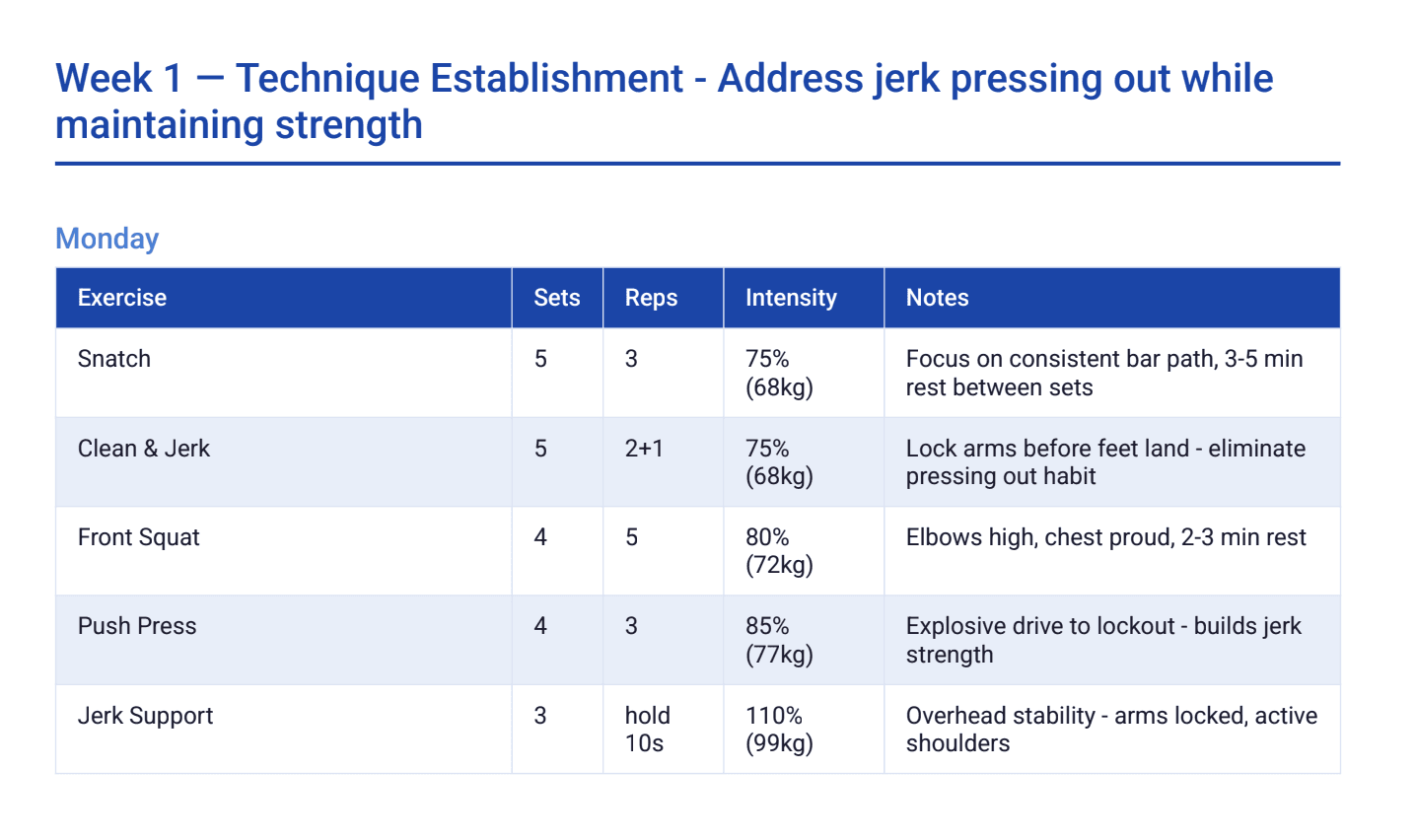
Every plan includes week-by-week programming with kg weights, coaching cues, and competition strategy.
Get mineReading the estimate
The training-gain projection in the calculator is deliberately conservative: roughly 1% of total per month for the first six months, tapering to 0.5% and then 0.25% per month beyond that, capped overall. It exists to sanity-check whether a gap is plausible in your timeframe — not to promise a number. Actual progress depends on training age, injury history, technical efficiency, and how well the block is actually built around your limiters, none of which a four-field calculator can see.
If the projection says your gap is out of reach through training alone in the time you have, that's useful information now, not disappointing information in three months. It means either extending your timeline to a later qualifying meet, seriously evaluating a weight-class change, or both.