
Olympic Lifting Without the Overtraining.A programme that changes when you miss a lift.
Log every set as you lift it. Miss one and today’s next set comes down; hit everything and the weeks ahead move up. Built for masters athletes and anyone who cannot afford another injury.
Start free for 14 daysCard up front, nothing charged for 14 days. · €19.90 / $21.90 a month after · cancel anytime
- ✓ Built around your lifts, your comp date, your injuries
- ✓ Loads that follow what you actually lifted
- ✓ A new block every cycle, built on the last one
- ✓ Every athlete's week in one console
- ✓ Change any load, set or exercise yourself
- ✓ Told when someone misses lifts or stops training
Built on sports science, not templates
Prilepin’s table, INOL load scoring, and a peak timed to your competition date
How It Works
Set your numbers once. The plan does the rest.
1. Set your numbers
Five minutes, once. Your current lifts, your competition date, the injuries you train around and the equipment you actually own.
2. Train, and log each set
One tap per set: done as prescribed, adjusted, or missed. It works with no signal in the gym and syncs when you are back on wifi.
3. The loads follow you
Miss a set and the next one comes down. Hit everything and the weeks ahead move up — scaled to the plates you own.
What it costs
Fourteen days free, then €19.90 / $21.90 a month. Cancel whenever you like.
- ✓ A full block built from your numbers
- ✓ Loads move with what you actually lift
- ✓ A new block each cycle, built on the last
- ✓ Log every set — works offline in the gym
- ✓ Export any block as a PDF
Card up front, nothing charged for 14 days.
Why not a generic template?
Here is exactly what you get that a spreadsheet cannot give you.
| Feature | Standard Templates | OlyLiftPlan |
|---|---|---|
| Volume prescription | ✗Static, one-size-fits-all | ✓Prilepin-calibrated per phase |
| Recovery management | ✗"Grind through it" mentality | ✓INOL-scored, fatigue-aware |
| Injury history | ✗Ignored | ✓Modifies sessions automatically |
| Age adaptation | ✗None | ✓Masters-specific overrides (M35+) |
| Taper | ✗Generic % cut | ✓Banister model, data-timed |
| Output | ✗Percentages only | ✓Exact kg weights per session |
How load is managed across your 12-week block
INOL score per session — calculated automatically, adjusted per phase.
Built on sports science, not templates
Every decision in your plan is backed by peer-reviewed research and Soviet-era training methodology. Here is how it works in practice.
Deep dive into the science and learning resourcesPrilepin's Table
Soviet rep-volume prescription, 1974
Working at 80–85%? The plan programmes 10–20 total reps on the competition lift — not 30 (overreach) and not 8 (wasted session). Volume is automatically calibrated to your phase: higher in accumulation, tighter in peaking.
INOL Load Scoring
Intensity × Number of Lifts index
Every session is scored using the INOL formula to prevent overreach. Accumulation weeks target 2.0–3.0 INOL per lift; taper week drops to 0.4–0.8. Your body gets the right dose at every stage of the peak.
Banister Fatigue-Fitness Model
Two-factor supercompensation theory
Fitness decays over ~45 days; fatigue clears in ~15. The plan times your final hard block so fatigue dissipates before competition day — volume drops 40–60% in the last 10–14 days while intensity is maintained to preserve the fitness signal.
Rate of Force Development
Velocity-specific training progression
Heavy squats build your force ceiling — but competition performance depends on how fast you express it. The plan progressively shifts from strength work to hang variations and speed pulls as the meet approaches, peaking RFD exactly when it matters.
Evidence-based training facts
Every OlyLiftPlan programme is built on decades of peer-reviewed research and Soviet coaching science.
Prilepin's Optimal Rep Volume
Soviet sports scientist A.S. Prilepin analysed thousands of elite lifting sessions. At 80–85% 1RM, 15 total reps is the target sweet spot. Programme fewer and the stimulus is wasted; programme more and technique degrades under accumulated fatigue.
Prilepin, A.S. · 1974 · Soviet Sports Science
Your plan adapts to your age — not just your lifts
Masters physiology differs enough from open athletes that generic elite programming can impair recovery and increase injury risk. OlyLiftPlan applies evidence-based masters-specific overrides automatically when you're 35 or older.
Elevated Protein Targets
Anabolic resistance — Wall et al., 2015
Masters athletes need ~3–4g leucine per meal to trigger muscle protein synthesis — nearly double the open-athlete threshold. The nutrition plan raises protein targets to 2.4–3.2 g/kg depending on phase, and specifies high-leucine sources at every feeding.
Speed Work in Every Phase
Type II fiber loss — Lexell et al., 1988
After 35, fast-twitch fibers decline at ~1% per year — directly reducing the explosive power that wins competitions. Masters plans include hang variations and speed pulls from week one, not just the peaking phase, to counteract this loss throughout the cycle.
Built-In Recovery Spacing
Session recovery windows + mandatory deloads
Heavy snatch and heavy clean & jerk are never programmed on back-to-back days for M40+ athletes. Deload weeks are mandatory every 3rd week (vs every 4th for open), and M45+ athletes get reduced volume load caps of 5% per week to protect tendon adaptation.
Age-specific programming built in automatically
Ready to peak on competition day?
€19.90 / $21.90 a month. Cancel anytime.
Start free for 14 days ›Less than one coaching session
Programme every athlete from one screen.
Each athlete gets a plan built around their own lifts, injuries and competition date, and logs every set against it. You see all of it, change any of it, and get told when someone misses lifts or stops turning up.
See the coach consoleWhat's inside your plan
Open it on your phone at the gym. It works with no signal.
Today's session
Every set, rep, % and kg for the day you are standing in
Tap to log a set
Done as prescribed, adjusted, or missed — three taps a set
Loads that follow you
Miss a set and the next comes down; hit everything and the weeks ahead move up
The overtraining guard
Every session scored with INOL, so a hard week cannot quietly become a stupid one
Coach oversight
Your coach sees what you logged and can change any session ahead
Export as a PDF
Any block, printed or on your phone, whenever you want it
Everything you need to peak perfectly.
Our AI engine analyses your strength ratios, technical flaws, and recovery capacity to build a plan that actually fits you. No cookie-cutter templates.
- Know exactly what your body can handle — strength ratios calculated, not guessed
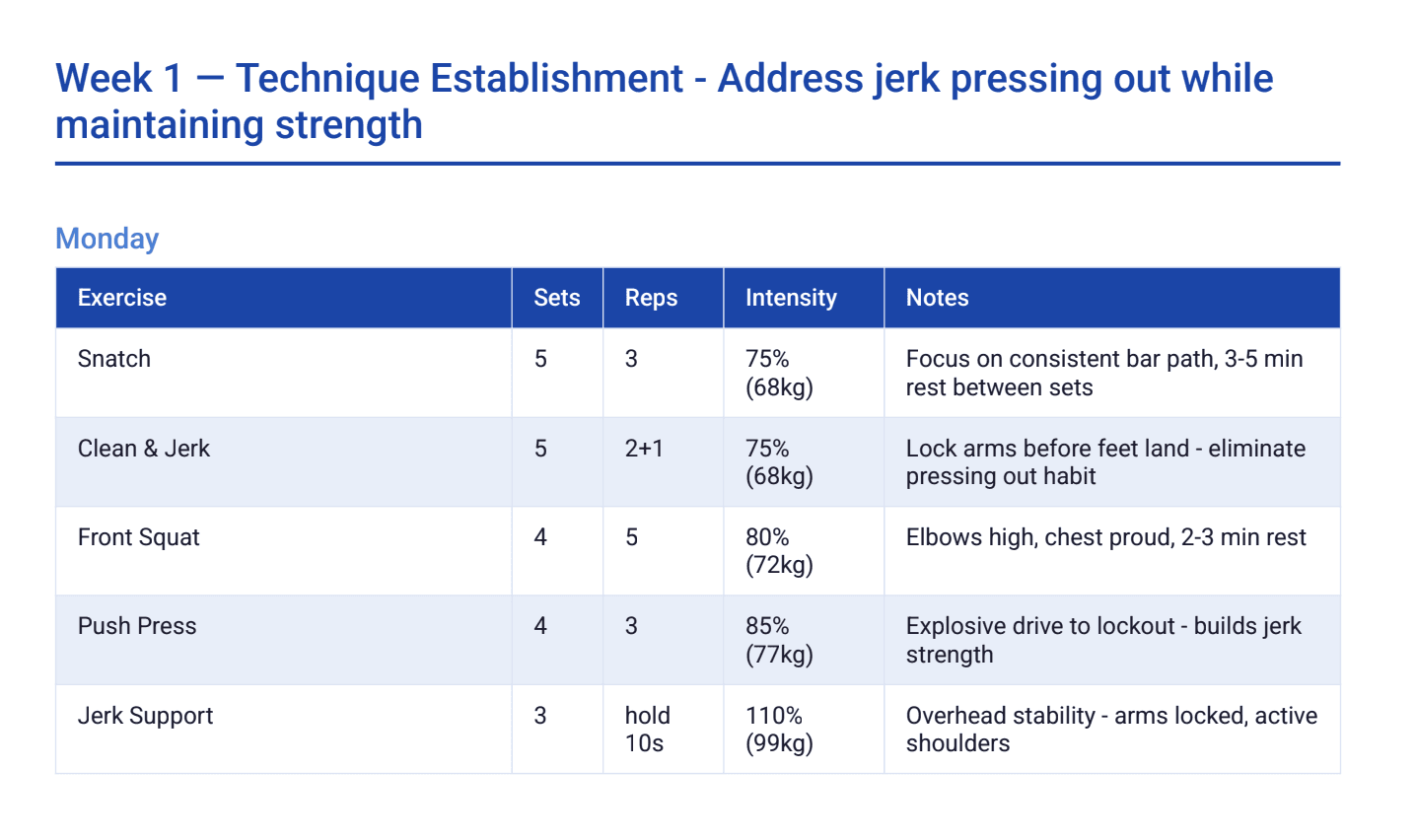
- Walk into every session knowing exactly what to do, in sets, reps, % and kg
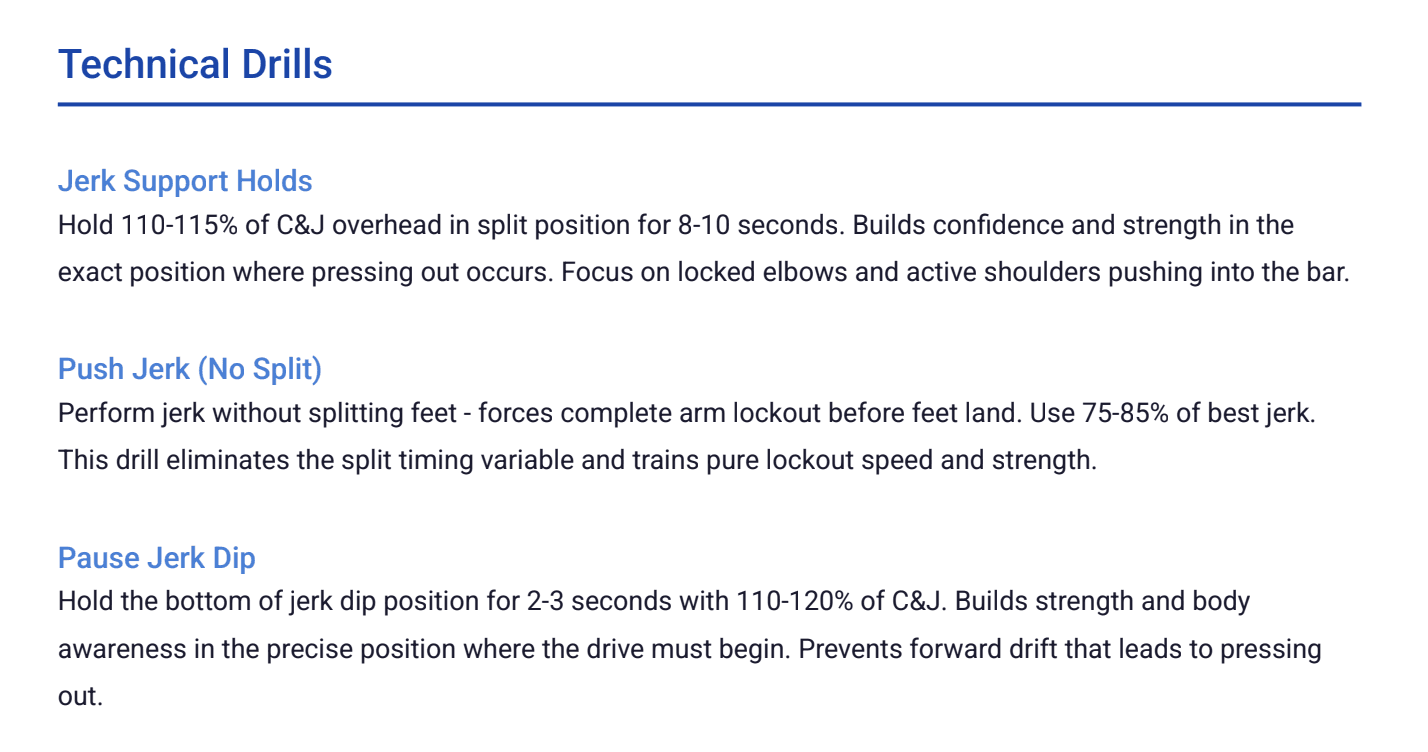
- Fix the one technical flaw that is costing you the most kilos on the platform
- Train around your injuries, not through them
- Recover faster between sessions so you can train harder
- Walk onto the platform knowing your openers cold
Frequently Asked Questions
Why not just hire a real coach?
A qualified S&C coach runs €80–150 (roughly $90–165) per session — before they've written a single programme. OlyLiftPlan gives you the same periodisation science, built around your exact numbers, for €19.90 / $21.90 a month. No scheduling, no commute, no weekly check-in fee.
How long does it take to receive my plan?
A few minutes. The engine analyses your numbers, writes every session of the block, and it is waiting on your Today screen when it finishes. You can start training the same day.
What format is the plan in, and how many weeks does it cover?
A screen per training day: today's session with every set, rep, percentage and kilo, which you tick off as you lift. It works with no signal in the gym. Any block exports as a PDF if you want it printed or on paper. A block covers the weeks between today and your competition date, up to 12.
What if my competition date changes?
Change it in your profile. The next block is built around the new date and re-peaks for it, so a competition that moves by a month does not cost you a programme.
What happens if I cancel?
Your plan stays readable and nothing is deleted — you keep every block you have trained and everything you logged. What stops is the new block each cycle and the loads moving with what you lift. You can export what you have as a PDF before or after cancelling, and you are billed to the end of the period you have paid for, not cut off the day you cancel.
Do I keep my plans?
Yes. Blocks you have already been given stay yours, readable in the app and exportable as a PDF, and nothing you logged is deleted.
Can my coach see everything I log?
If you are on a coach's roster, yes — that is the point of them being there. They see which sessions you completed, what you actually lifted, and which sets you missed, and they can change any session ahead of you. An exercise your coach edits is left alone by the automatic load adjustment, so their decision stands. Nobody sees your training unless you accept their invitation.
What if I miss a week of training?
Nothing is lost and nothing is marked against you. The app offers to move the rest of the block forward so you pick up where you left off rather than starting mid-plan with a week missing. Training maxes only move on what you actually lifted, so a week off does not push your loads up behind your back.
I'm a masters lifter (35+) — will this work for me?
Yes — and it's built specifically for you. When you're 35 or older the plan automatically applies masters-specific protocols: elevated protein targets to overcome anabolic resistance, speed work in every phase (not just peaking) to counteract fast-twitch fiber loss, mandatory deload weeks every 2nd–3rd week, and tighter weight-cut thresholds to protect muscle mass. M40+ athletes also get session spacing rules that prevent heavy snatch and heavy clean & jerk on back-to-back days. These aren't options — they're built in.
What if I have an injury?
The form includes a dedicated injury section. The AI automatically substitutes exercises that aggravate your specific injury areas — for example, swapping heavy back squats for front squats if you have lower back issues — without sacrificing peaking quality.
The science behind your plan
Evidence-based guides to periodization, peaking, and competition preparation.
Prilepin's Table Explained for Olympic Weightlifting
The Soviet prescription table that defines how many reps you should do at each intensity. Most lifters programme too much or too little volume — here's how to get it right.
Read →ProgrammingINOL Load Scoring: The Formula That Prevents Overreach + Free Calculator
INOL converts your sets, reps, and intensity into a single stress number. Learn the targets for each training phase — and how to know when a session is too much.
Read →Competition PrepHow to Peak for a Weightlifting Competition
A framework for the 12 weeks before your meet: which periodization model to choose, how to structure your phases, and how to time the taper so fatigue clears on competition day.
Read →Athlete AnalysisStrength Ratios in Olympic Weightlifting: What Your Numbers Reveal
Your Snatch : C&J ratio tells you more about your limiters than almost any other number. Here are the elite benchmarks, what each gap means, and how to fix it.
Read →