55–90%
Intensity zones
covered by the table
4
Intensity bands
each with rep targets
1974
Original publication
Prilepin, A.S.
In 1974, Soviet sports scientist A.S. Prilepin published a deceptively simple table based on analysis of thousands of elite weightlifting sessions. His finding: there is an optimal number of repetitions at each intensity zone. Programme too few and the session is wasted. Programme too many and you accumulate fatigue that erodes technique and delays recovery.
Five decades later, Prilepin's Table remains the most widely used volume-prescription tool in Olympic weightlifting — cited in Mel Siff's foundational text Supertraining (2003) and applied in programming systems across Eastern Europe, China, and the United States.
The Table
| Intensity (% 1RM) | Reps per Set | Optimal Total Reps | Acceptable Range |
|---|---|---|---|
| 55–65% | 3–6 | 24 | 18–30 |
| 70–75% | 3–6 | 18 | 12–24 |
| 80–85% | 2–4 | 15 | 10–20 |
| 90%+ | 1–2 | 7 | 4–10 |
The "Optimal Total Reps" column is your target. The "Acceptable Range" gives you flexibility around it — but staying within that range is the point. If you're programming 30 reps at 80%, you're in overreach territory. If you're doing 6, you're leaving adaptation on the table.
Why it works
The table reflects a simple physiological reality: the nervous system has a finite capacity to produce high-quality explosive output. Prilepin's data showed that beyond the upper threshold, technique deteriorated and training effect declined regardless of intent.
This is particularly true for the competition lifts — snatch and clean & jerk — which require near-maximal neuromuscular coordination on every rep. Unlike powerlifting movements, where a technically sloppy rep is still a training stimulus, a technically broken snatch is actively harmful: it reinforces poor patterns and risks injury.
“The optimal total number of repetitions reflects the point at which training quality begins to decay faster than accumulated training volume produces adaptation.”
How to apply it across a peaking cycle
The table works differently in each phase. Prilepin gave us the band — your phase determines where in the band you sit:
| Phase | Where to sit in the range | Rationale |
|---|---|---|
| Accumulation (12–8 wk out) | Upper half — approach the maximum | Volume drives hypertrophy and technique volume |
| Intensification (8–4 wk out) | Optimal column target | Build work capacity at competition-specific loads |
| Peaking (4–1 wk out) | Lower half — below optimal | Intensity climbs; each rep must be competition-quality |
| Taper (final week) | Minimum of the range | Fatigue clearance; quality over quantity absolutely |
A worked example: 8-week prep at 82%
Suppose your snatch training max is 110 kg. You're 8 weeks out, entering your intensification phase. At 82% (90 kg), Prilepin says your optimal total reps are 15, with an acceptable range of 10–20.
A standard prescription: 5 sets × 3 reps @ 90 kg = 15 total reps. Exactly optimal. If you feel strong in week 3, you might push to 5×4 = 20 reps — still within range. If you're fatigued or returning from illness, 4×3 = 12 reps keeps you in acceptable territory without losing the session.
Worked example — Snatch at 82%
Training max: 110 kg → 82% = 90 kg
5 sets × 3 reps = 15 total reps ✓ optimal
Acceptable: 10–20 reps | Avoid: >20 reps at this intensity
Common mistakes
Applying the table to accessory work. Prilepin's Table was derived from competition lift data — snatch, clean & jerk, and their direct variations. It is not a prescription for squats, pulls, or presses, where higher volumes at sub-maximal intensities are appropriate and well-tolerated.
Treating the optimal column as a minimum. Many intermediate lifters assume more volume is always better. Prilepin's data says the opposite: exceeding the upper acceptable range does not produce more adaptation — it produces more fatigue and lower quality.
Using 1RM, not training max. The percentages are based on your current reliable training maximum — the weight you can hit on any given day. Using your all-time best inflates the intensity calculation and pushes you into the overreach zone without realising it.
Sample from an OlyLiftPlan PDF
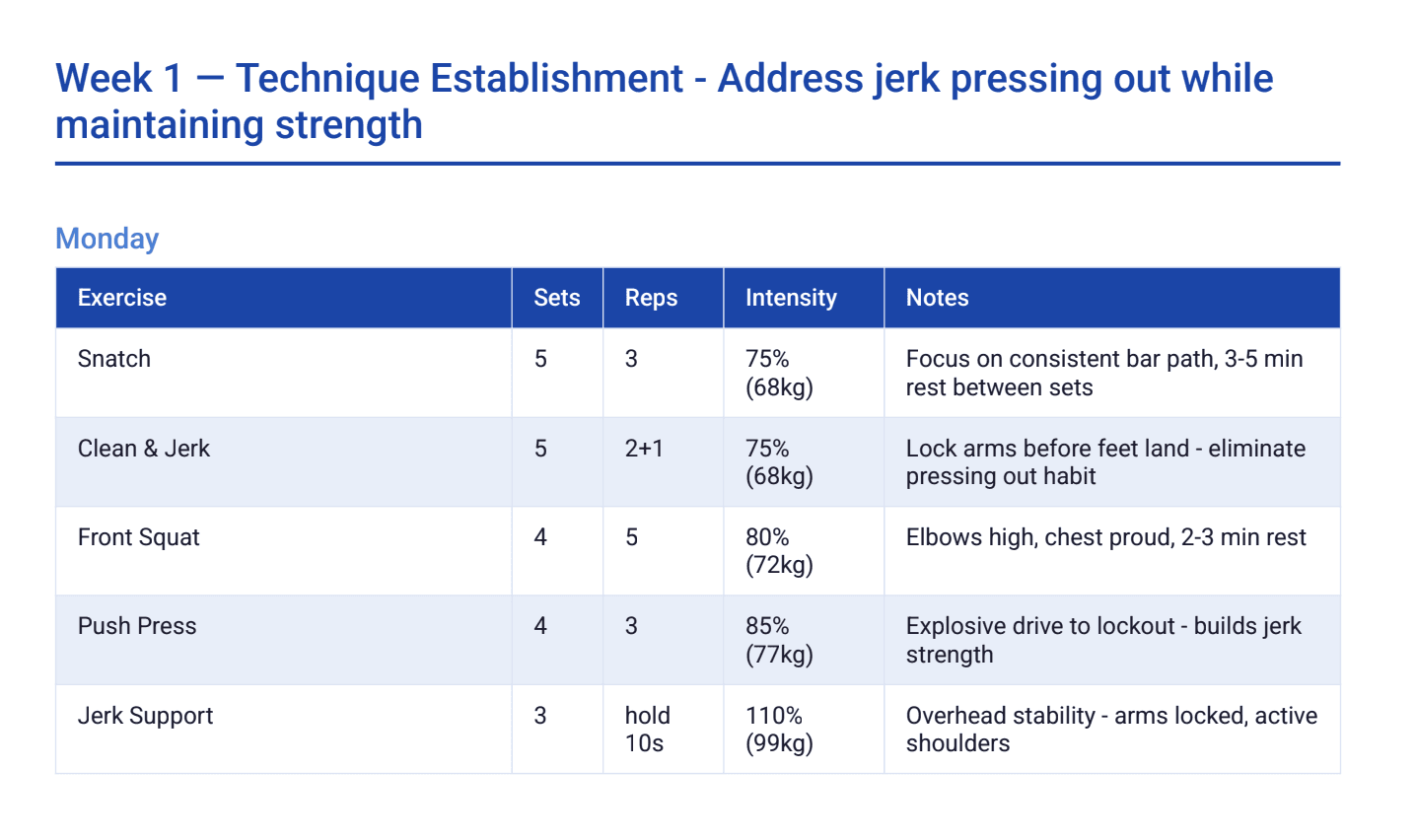
Every plan includes week-by-week programming with kg weights, coaching cues, and competition strategy.
Get minePairing with INOL
Prilepin's Table tells you the total rep count. INOL (Intensity × Number of Lifts) gives you a single stress number that combines both load and volume. Used together, they cross-check each other: 5×3 @ 82% = 0.75 INOL, which falls comfortably in the optimal training zone (0.4–1.0) — a good sign that the prescription is reasonable before you even step on the platform.
See the full INOL guide for how to use both tools together to audit your weekly programming.
References
- Prilepin, A.S. (1974). Weightlifting: Fundamentals and Methods. Referenced in: Siff, M.C. (2003). Supertraining (6th ed.). Supertraining Institute.