0.82–0.87
Elite Snatch : C&J
international standard
0.79–0.90
Elite C&J : Back Squat
strength indicator
>10%
Deviation = primary limiter
must address first
Every Olympic weightlifter has a ratio problem. The question is which one — and how to prioritise fixing it within a finite competition prep window. Strength ratio analysis is the fastest way to identify what is actually limiting your total, as opposed to what you assume is limiting it.
The ratios described here are not arbitrary guidelines. They reflect decades of data from elite lifters and are used in Soviet, Chinese, and modern evidence-based coaching systems to allocate training emphasis across a competition cycle.
Research on elite international weightlifters confirms what coaches have long observed: squat strength is among the strongest predictors of competition performance. A 2024 study of athletes competing at the IWF World Championships found near-perfect correlations between front and back squat 1RMs and snatch and clean & jerk performance (r = 0.98–0.99). This makes ratio analysis a genuinely useful diagnostic tool, not just a rule of thumb. (Martínez-García et al., Applied Sciences, 2024)
The key ratios
| Ratio | Developing | Advanced | Elite |
|---|---|---|---|
| Snatch / Back Squat | 0.60–0.65 | 0.65–0.72 | 0.73–0.82 |
| Clean & Jerk / Front Squat | 0.78–0.83 | 0.83–0.88 | 0.88–0.94 |
| Front Squat / Back Squat | 0.82–0.86 | 0.86–0.90 | 0.90–0.96 |
| Snatch / Clean & Jerk | 0.76–0.79 | 0.79–0.82 | 0.82–0.87 |
| C&J / Bodyweight (men) | 1.5–1.8× | 1.8–2.1× | 2.1–2.5× |
| C&J / Bodyweight (women) | 1.2–1.5× | 1.5–1.8× | 1.8–2.1× |
See where you sit against these benchmarks right now — the calculator below computes all five ratios and flags your priority automatically.
Free Strength Ratio Calculator
Your biggest gap is Clean & Jerk / Bodyweight — 13% below the advanced benchmark. That's your priority for the next training block.
What each ratio tells you
Snatch / Back Squat (elite: 0.73–0.82)
This is the most reliable indicator of whether technique or strength is your primary snatch limiter. A ratio below 0.65 means your snatch is disproportionately low relative to your squat — technique is the problem, not leg strength. Adding more squats will not help.
A ratio above 0.82 has the opposite implication: your snatch is high relative to your squat strength. You are technically efficient, but you are approaching the ceiling of what your strength base can support. Priority shifts to squatting and pulling.
Note that limb proportions affect individual ratios — longer limbs typically produce lower snatch-to-squat ratios — so deviations from the benchmark are not always a training problem.
Snatch / Clean & Jerk (elite: 0.82–0.87)
Below 0.77: a significant snatch technique issue. The athlete is leaving substantial snatch performance on the table due to technical breakdown, not strength deficiency. The prescription is to reduce clean & jerk volume and shift emphasis to snatch correctives.
Below 0.79: the snatch is underdeveloped relative to the clean, but not critically so. A moderate rebalancing of training emphasis is warranted.
Any ratio deviating more than 10% from the advanced benchmarks indicates that movement chain is the primary performance limiter and must be addressed first in block planning.
Clean & Jerk / Front Squat (elite: 0.88–0.94)
Below 0.85: the jerk, not the clean, is limiting the C&J total. The athlete can front squat significantly more than they can jerk, which points to either a technical jerk issue (dip mechanics, split position, pressing out) or an underdeveloped pressing strength pattern.
Front Squat / Back Squat (elite: 0.90–0.96)
Below 0.86 indicates anterior chain weakness. The lifter is relatively stronger in the back squat pattern than the front squat — which translates to difficulty in the receiving positions of both the snatch and the clean. Prioritise front squatting.
Interestingly, a 2024 study of IWF World Championship athletes found that ballistic capability — specifically propulsive impulse during a countermovement jump — correlates with competition performance nearly as strongly as squat strength (r = 0.98–0.99). This suggests that ratio gaps are not purely a strength problem: power development and rate of force development matter alongside raw maximal strength.
Is there an official USA Weightlifting ratio standard?
Not from the federation itself — USA Weightlifting has never published an official snatch-to-back-squat ratio standard. What lifters usually mean when they search for “USA Weightlifting ratio standards” is coach Greg Everett's widely circulated Olympic Weightlifting Skill Levels chart (Catalyst Athletics) — an independent classification system built specifically around American competitive data, as an alternative to the Soviet-derived numbers most ratio guides (including the benchmarks above) are based on.
Everett's guideline puts the back squat at roughly 125–135% of the clean, and the snatch at roughly 78–83% of the clean & jerk — figures that sit in the same range as the Soviet-derived ratios in the table above, which is reassuring rather than contradictory. He is explicit that these are loose guidelines, not diagnostic thresholds: individual limb length, technical proficiency, and training age all shift the numbers, and the chart is meant to set goals, not flag problems.
Elite benchmarks by weight class
| Weight Class | Snatch (kg) | Clean & Jerk (kg) | Total (kg) |
|---|---|---|---|
| 60 kg | 117–138 | 149–171 | 275–302 |
| 65 kg | 133–145 | 162–183 | 295–324 |
| 71 kg | 136–160 | 175–195 | 312–346 |
| 79 kg | 148–167 | 184–204 | 336–361 |
| 88 kg | 152–180 | 185–215 | 340–387 |
| 94 kg | 160–182 | 201–222 | 367–395 |
| 110 kg | 174–196 | 210–233 | 387–428 |
| 110+ kg | 164–211 | 201–261 | 367–461 |
| Weight Class | Snatch (kg) | Clean & Jerk (kg) | Total (kg) |
|---|---|---|---|
| 48 kg | 77–91 | 96–122 | 175–213 |
| 53 kg | 80–96 | 101–127 | 181–214 |
| 58 kg | 91–104 | 112–134 | 207–236 |
| 63 kg | 93–111 | 115–142 | 215–253 |
| 69 kg | 100–120 | 121–150 | 221–270 |
| 77 kg | 103–123 | 130–155 | 236–278 |
| 86 kg | 103–123 | 131–153 | 236–272 |
| 86+ kg | 106–130 | 136–166 | 242–283 |
Accessory strength benchmarks
| Exercise | Men (relative to BW) | Women (relative to BW) |
|---|---|---|
| Back Squat | 2.2–2.8× | 1.8–2.3× |
| Front Squat | 2.0–2.5× | 1.6–2.1× |
| Clean Pull | 1.3–1.5× C&J | 1.3–1.5× C&J |
| Snatch Pull | 1.1–1.3× Snatch | 1.1–1.3× Snatch |
| Strict Press | 0.60–0.75× BW | 0.45–0.60× BW |
| Weighted Pull-up | BW + 40–70% | BW + 20–40% |
Sample from an OlyLiftPlan PDF
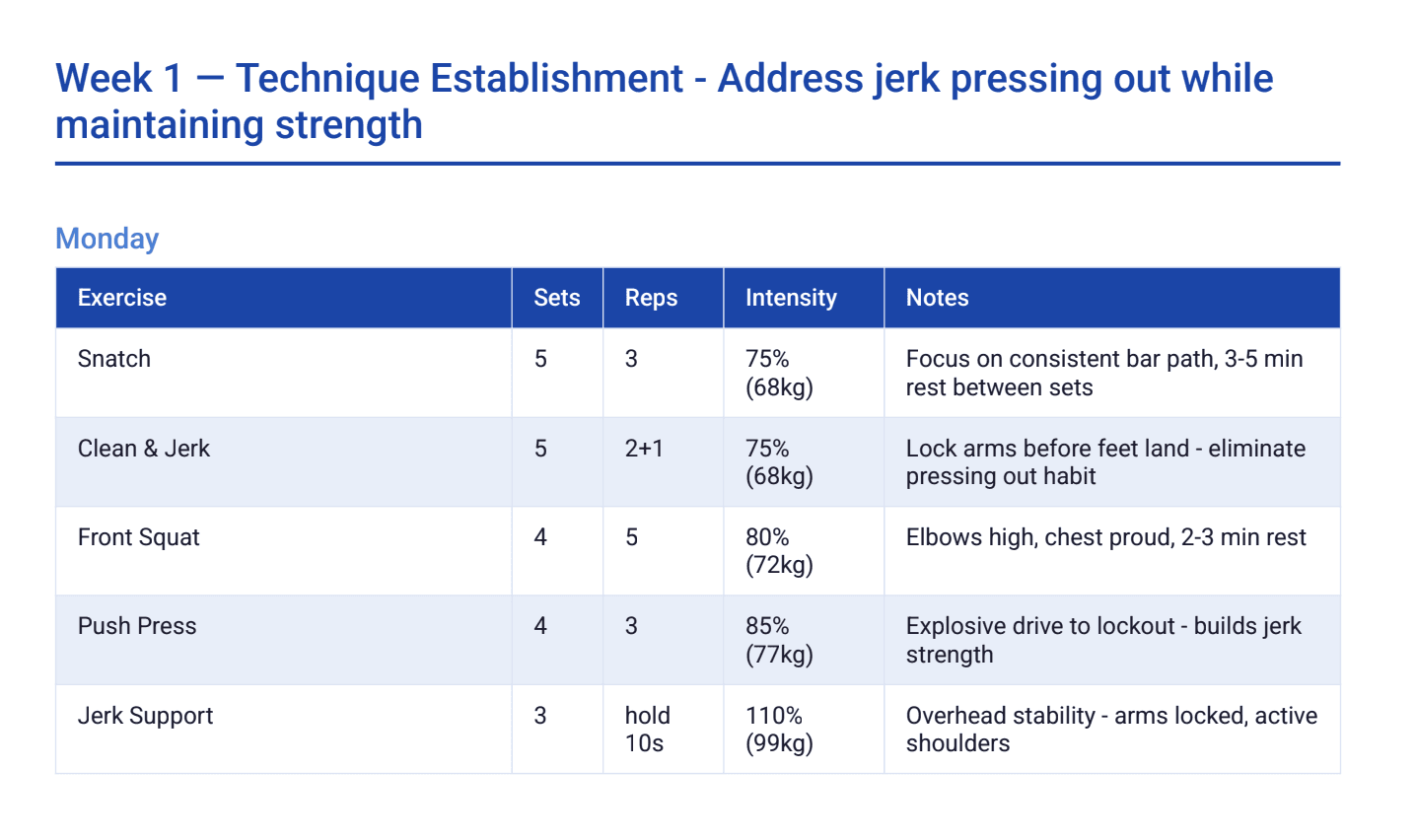
Every plan includes week-by-week programming with kg weights, coaching cues, and competition strategy.
Get mineHow to use this in practice
Calculate all five ratios from your current training maxes — not your all-time bests. This gives you an honest picture of current capacity. Then identify which ratio deviates most from the advanced benchmarks. That deviation is your primary training priority for the next 4-week block.
A common mistake is addressing multiple ratio gaps simultaneously. The nervous system does not respond well to competing demands. Pick one limiter, address it aggressively for 4–6 weeks, then re-assess.
An important caveat: these benchmarks describe international and national elite performance. Most club competitors will sit in the "developing" column. That is not a problem — it simply means there is abundant room for technical and strength development, and the ratio analysis is especially useful because the gaps tend to be larger and clearer.
Masters lifters deserve a specific note: as athletes age, competition lift performance tends to decline faster than maximal squat strength. This means masters lifters often display higher-than-expected strength ratios while their totals plateau. If your ratios look strong but your total has stalled, the issue is more likely speed and power development than raw strength.
If your ratios look good but your total has stalled, test your countermovement jump height or measure propulsive impulse. When strength is not the limiter, power development and rate of force development are — and these respond to speed-strength work (hang variations, drop snatches, speed squats) rather than more maximal lifting.
References
- Martínez-García D, et al. Neuromuscular Capabilities in Top-Level Weightlifters and Their Association with Weightlifting Performance. Applied Sciences. 2024;14(9):3762. https://doi.org/10.3390/app14093762
- Everett G. The Relation of Snatch, Clean & Jerk and Squat Weights. Catalyst Athletics. May 2013. catalystathletics.com/article/1786
- Adams A. If you can squat X can you snatch Y? Ratios of efficiency in lifting. StandFast Barbell. January 2021. standfastbarbell.com/articles/2021/1/20
- Everett G. Olympic Weightlifting Skill Levels Chart. Catalyst Athletics. catalystathletics.com/article/1836