12 wk
Maximum peak length
beyond this, phases compress
40–60%
Volume drop in taper
intensity maintained
10–14 days
Optimal taper window
Banister et al., 1975
Peaking is not just about getting strong. It is about arriving at competition day with the right balance: enough accumulated fitness to lift big, and enough recovered freshness to actually express it. Getting that balance wrong — in either direction — is the most common reason athletes underperform relative to their gym numbers.
This guide covers the full framework: how to select a periodization model, how to structure your phases, and how to time the taper so that fatigue clears exactly when it needs to.
Step 1: Choose your periodization model
Your weeks out and athlete profile determine which model to use. There is no universally superior system — there is a best fit for each situation.
| Model | Best for | Avoid if |
|---|---|---|
| Block periodization | Athletes >10 weeks out, significant technical gaps, masters athletes (35+) | Very short prep windows (<6 weeks) |
| Modified Bulgarian | Elite athletes, <8 weeks out, technically solid, strong recovery | Masters M40+; athletes with significant injury history |
| DUP / Conjugate hybrid | Athletes with broad strength imbalances, intermediate level | Athletes close to peak who need specificity, not variety |
Block periodization is the default for most athletes preparing their first serious competition peaks. It is predictable, evidence-supported, and forgiving of imperfect execution. Bulgarian-style daily maxing requires exceptional recovery capacity and technical mastery — applied to the wrong athlete it produces overtraining, not peaking.
Step 2: Structure your phases
| Phase | Weeks out | Primary focus | Intensity range |
|---|---|---|---|
| GPP / Accumulation | 12–8 | Volume, technique refinement, strength base | 65–80% |
| SPP / Intensification | 8–4 | Sport-specific volume, rising intensity | 75–88% |
| Competition prep | 4–2 | Peaking — heavy singles and doubles | 85–95%+ |
| Taper | 2–1 | Fatigue clearance — volume drops sharply | 88–100% |
| Peak week | Competition week | Openers, sharpening — no new stimuli | 85–95% |
The most common error is spending too long in accumulation and arriving at the competition prep phase with insufficient time to sharpen. As a rule of thumb: if you have 12 weeks, split roughly 4 / 4 / 2 / 2 across the phases. If you have 8 weeks, compress the accumulation and protect the taper.
Step 3: Use Prilepin's Table to calibrate volume
Within each phase, Prilepin's Table determines how many total reps to programme at each intensity zone. At 80–85%, the optimal total is 15 reps per session; at 90%+, the optimal drops to 7 reps. The phase determines where in the acceptable range you sit — upper half during accumulation, lower half during peaking.
Cross-check with INOL: most sessions should score 0.4–1.0 per competition lift. Accumulation weeks may reach 1.0–1.5 on the hardest days, but should not sustain that level throughout the phase.
Sample from an OlyLiftPlan PDF
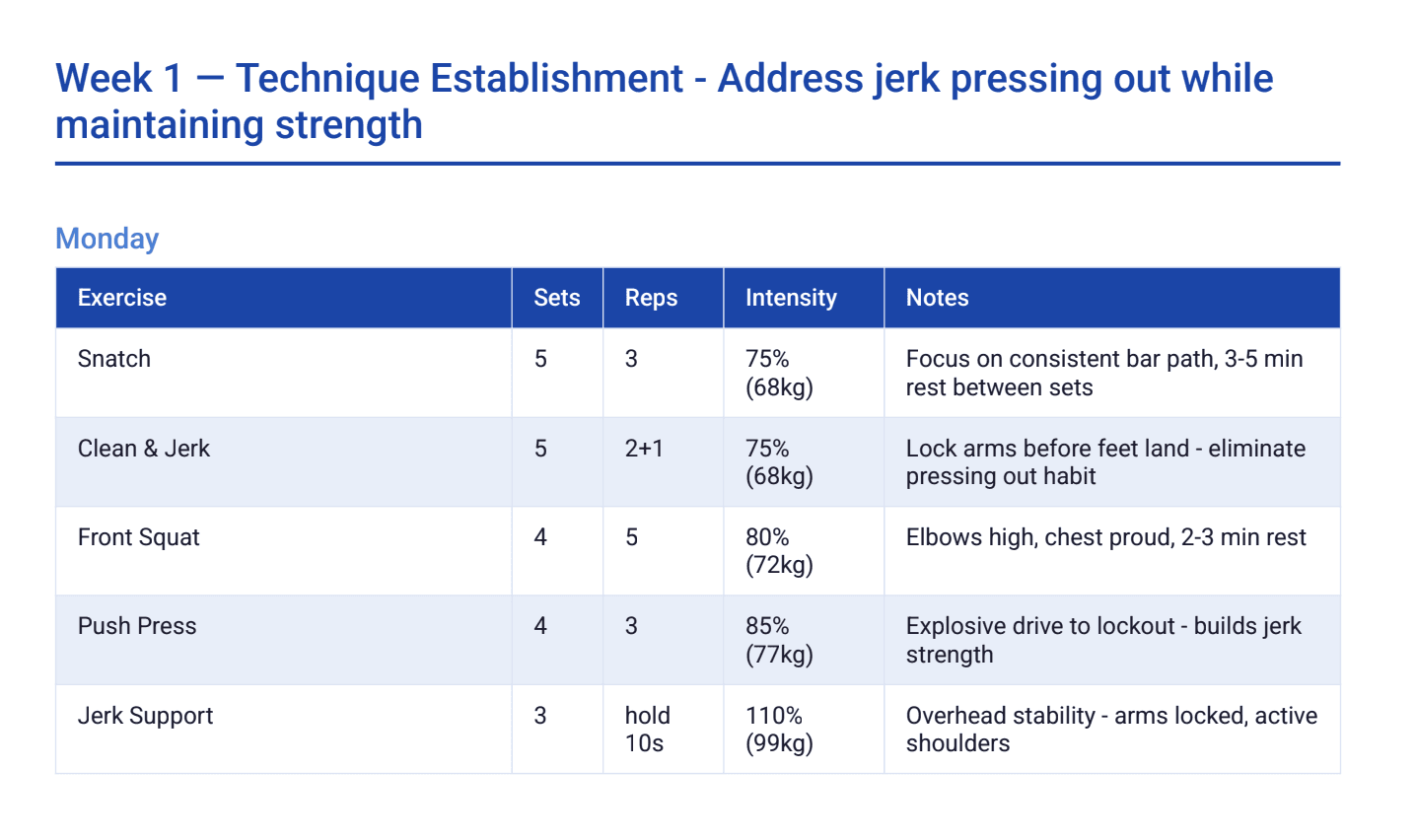
Every plan includes week-by-week programming with kg weights, coaching cues, and competition strategy.
Get mineStep 4: Time the taper correctly
The taper is the most misunderstood part of the peak. Many athletes either taper too early (fitness decays before competition day) or too late (fatigue has not cleared). The Banister Fatigue-Fitness Model gives us the mathematics behind the timing:
Fitness has a half-life of approximately 45 days — it decays slowly. Fatigue has a half-life of approximately 15 days — it clears quickly. A 10–14 day taper is optimal: long enough to clear fatigue, short enough to preserve nearly all fitness.
In practice: begin your taper 10–14 days before competition. Drop total volume by 40–60% compared to your peak accumulation week. Keep intensity at 88–95% — or even attempt openers at 95%+ of your planned competition loads. Do not reduce intensity to "save yourself". The fitness signal is maintained through intensity, not volume.
Step 5: Programme for Rate of Force Development
Raw strength and competition performance are not the same thing. Olympic lifting is determined primarily by peak power and rate of force development (RFD) — how quickly you can express the strength you have. This is why the exercise selection must shift across the peak:
| Phase | Primary exercises | Goal |
|---|---|---|
| Accumulation | Heavy squats, pulls, competition lifts at moderate % | Build force ceiling |
| Intensification | Mix of strength and hang/block variations | Transfer strength to power |
| Peaking | Hang variations, speed pulls, competition singles | Sharpen RFD for meet day |
| Taper | Competition-weight singles, openers | Neural readiness only |
Aagaard et al. (2002) demonstrated that neural drive — the nervous system's ability to recruit motor units rapidly — increases significantly following strength training but requires speed-specific stimuli to fully express as RFD. Programming only heavy squats through the peak produces a strong but slow athlete.
Red flags to watch during the peak
Competition total < 85% of gym total. This is a mental performance issue, not a programming failure. Add competition simulation sessions — attempt selection at competition-weight loads, with the full warm-up routine — to close the gap.
Recent result more than 5% below all-time best. Do not add volume to address this. It is almost always fatigue, overtraining, or a minor injury. Review load management before adding anything.
Required weight cut exceeds 7% of bodyweight. This is medically inadvisable and likely to impair performance more than competing in the higher weight class. Flag this early — ideally at 8+ weeks out when you still have time for a dietary-only cut.
References
- Prilepin, A.S. (1974). Weightlifting: Fundamentals and Methods. Referenced in: Siff, M.C. (2003). Supertraining (6th ed.). Supertraining Institute.
- Banister, E.W., Calvert, T.W., Savage, M.V., & Bach, T. (1975). A systems model of training for athletic performance. Australian Journal of Sports Medicine, 7(3), 57–61.
- Chiu, L.Z.F., & Barnes, J.L. (2003). The fitness-fatigue model revisited. Strength and Conditioning Journal, 25(6), 42–51.
- Aagaard, P. et al. (2002). Increased rate of force development and neural drive following resistance training. Journal of Applied Physiology, 93(4), 1318–1326.