>50
VO₂max ml/kg/min
elite CrossFit athletes — Schlegel et al., 2020
1.5×
Bodyweight back squat
minimum benchmark for C&J ceiling
2–3×
Weekly lift frequency
minimum for skill development
CrossFit develops an impressive athletic foundation: aerobic capacity, general strength, exposure to the Olympic lifts, and a high tolerance for hard work. If you've been training CrossFit seriously for a year or more and have become drawn to the snatch and clean & jerk, you're not starting from zero. But you are starting a different sport — and the transition requires deliberate reprogramming, of your training and potentially of your assumptions.
What CrossFit does and doesn't develop
Elite CrossFit athletes have been shown to have above-average VO₂max and strong anaerobic capacity, alongside excellent performance on Olympic weightlifting movements (Schlegel et al., 2020). The problem isn't your general fitness — it's specificity.
Olympic weightlifting performance is built on three things: technical proficiency, maximal strength, and power expression. CrossFit gives you exposure to the movements and some strength, but the high-rep, fast-paced, fatigued context in which most CrossFitters practise the lifts is structurally opposed to developing elite technique. You need slow, deliberate, well-coached repetitions at moderate to heavy loads — not 30 snatches for time.
“Performing Olympic lifts in WOD-style settings often does not effectively translate to Olympic weightlifting performance. The skill requires focused practice, not fatigued repetition.”
The transition: what needs to change
1. Prioritise technical practice over volume
In CrossFit, more reps often means more adaptation. In Olympic weightlifting, more quality reps — performed fresh, with full attention to positions, timing, and bar path — are what drive improvement. Most elite lifters spend the majority of their training time at 70–80% of maximum, where technique can be reinforced under meaningful load without breakdown.
| Intensity zone | Volume | Purpose |
|---|---|---|
| 70–80% of 1RM | Majority of session volume | Technical reinforcement — high movement quality |
| 80–90% of 1RM | Moderate volume | Exposure to challenging loads, confidence-building |
| 90%+ | Low volume | Peaking stimulus, competition specificity |
If your training has been mostly high-rep metcon work, this shift to lower-volume, higher-quality technical work will feel frustratingly slow. That's the adaptation working.
2. Add frequency before intensity
The Olympic lifts are skills first and strength expressions second. Like any skill, they improve with frequency. The evidence-based recommendation for CrossFitters transitioning to dedicated weightlifting is to snatch and clean & jerk at minimum twice per week, ideally three times. Recreational CrossFitters looking to improve general Olympic lifting technique can find success training the movements 2–3 days per week for 30 minutes per session.
At this stage, the goal is not heavy lifting — it's building a reliable motor pattern. Low to moderate loads, full technical focus, and consistency over weeks.
3. Reduce conditioning volume progressively
This is the hardest part for athletes with a CrossFit identity. The research on concurrent training is clear: high-intensity conditioning suppresses the mTOR signalling pathway that drives strength and power adaptation. Moderate-intensity conditioning (Zone 2 cardio) is far less disruptive than high-intensity metcons (Hawley et al., 2014). A pragmatic transition approach:
| Phase | WOD frequency | Conditioning type | Lifting days |
|---|---|---|---|
| Weeks 1–8 | 2–3× per week | Moderate intensity — reduce max efforts | 2× per week |
| Weeks 8–16 | 1–2× per week | Low intensity — Zone 2 only | 3× per week |
| Pre-competition (4–6 weeks out) | 1× per week | Maintenance only — no barbell conditioning | 4–5× per week |
4. Strength work is non-negotiable
Many CrossFitters underestimate how strength-limited they are for weightlifting. The back squat is the cornerstone. A useful benchmark: if you can't back squat 1.5× your bodyweight for a solid double, your squat is likely limiting your clean & jerk ceiling. Front squat strength directly supports the receiving position in the clean.
The basic strength template for a developing weightlifter: 3–5 sets of 3–5 reps on squats, pulls, and overhead strength movements — progressed weekly or every other week as strength improves.
Sample from an OlyLiftPlan PDF
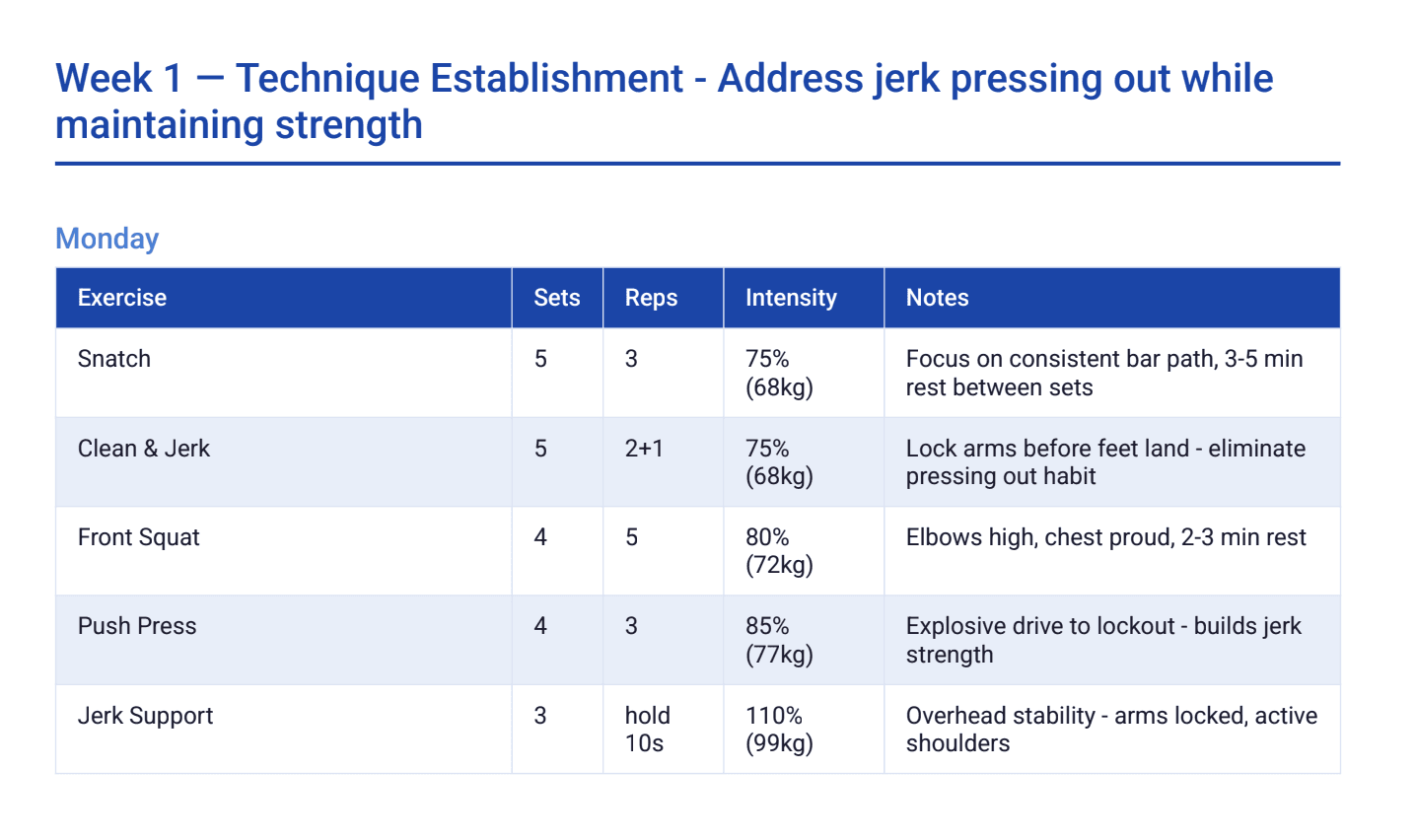
Every plan includes week-by-week programming with kg weights, coaching cues, and competition strategy.
Get mineThe mental transition
CrossFit rewards intensity. Weightlifting rewards precision. This is a cultural and psychological shift as much as a physical one. Progress on the platform is measured in single kilograms over months of focused work. The competitive CrossFit mindset — push harder, move faster, embrace the pain — needs to be balanced with patience, technical obsession, and a willingness to miss attempts cleanly rather than muscle through them.
“The athletes who make the fastest progress in this transition are almost always the ones who let go of their conditioning identity first and trust the process of technical development.”
Programming for the transition
One of the genuine challenges of this transition is that generic weightlifting programmes are not built for athletes carrying significant conditioning volume. A 6-day Bulgarian programme assumes you're doing nothing else. That's not your reality.
Effective transition programming needs to account for your current WOD frequency, your strength levels, your technical weaknesses, and your competition timeline simultaneously. This is exactly the kind of individualised, constraint-aware programming that OlyLiftPlan is designed to generate — tailored specifically to athletes managing the CrossFit-to-weightlifting shift.
References
- Schlegel, P. (2020). CrossFit® training strategies from the perspective of concurrent training: a systematic review. Journal of Sports Science and Medicine, 19(4), 670–680. PMC7675627
- Hawley, J.A. et al. (2014). Using molecular biology to maximize concurrent training. Sports Medicine, 44(Suppl 2), S117–S125. PMC4213370
- BarBend. How many times a week should you train the Olympic lifts? barbend.com
- Frontiers in Sports and Active Living (2025). The effects, mechanisms, and influencing factors of concurrent strength and endurance training with different sequences. PMC12885173